Why Your Effort Feels Different in the Back Row of a Spin Class
Quick Answer: Position in a studio changes your effort through three routes: temperature, since heat pools unevenly and front rows usually sit in the fan flow; sightlines, since seeing other riders drives pacing more than instruction does; and airflow, which affects both cooling and perceived exertion. Back rows are typically hotter, less socially paced, and produce lower measured output at the same perceived effort.
You arrived late, took a bike at the back, and the class was inexplicably harder than usual.
The bike was set the same. The playlist was the same. Almost everything else was not.

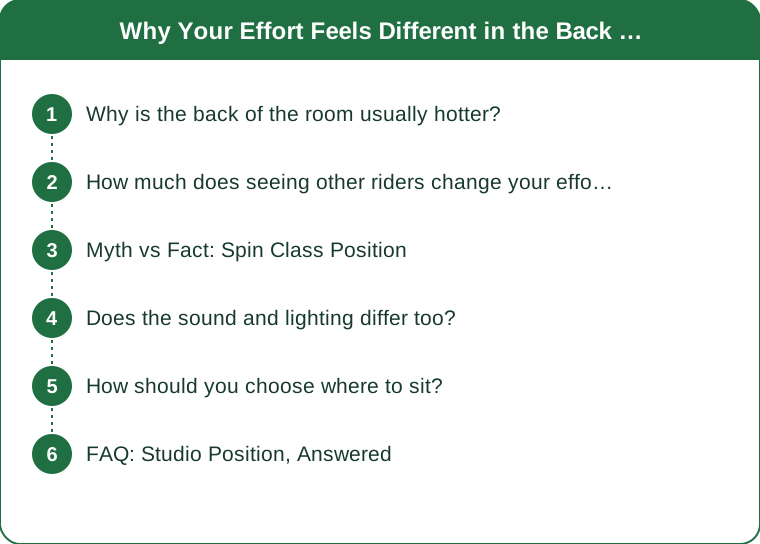
Why is the back of the room usually hotter?
Because studios are ventilated for the front and heat behaves predictably.
Most cycling studios position fans and air conditioning to cover the instructor and the front of the room, where the intended focal point is. Airflow reaching the back rows is typically much reduced and often close to nil.
Meanwhile, forty people producing sustained effort generate a substantial amount of heat, and warm air rises and moves toward the back and upper areas of a room.
A temperature difference of several degrees between the front and back of a busy studio is common, and heat is one of the strongest modifiers of perceived exertion there is. At the same power output, a hotter environment raises heart rate, increases perceived effort, and reduces the power you can sustain.
This is not marginal. Heat stress meaningfully reduces sustainable output well before it becomes uncomfortable enough to notice as heat, which is why riders in the back often report the class feeling harder without identifying temperature as the cause. They register the effort, not the reason for it.
How much does seeing other riders change your effort?
More than most people would like to admit.
In the front row, you can see almost nobody. Your pacing comes from the instructor, the music, and your own sensations.
In the back, you can see everyone. And there is a well-documented tendency for people to raise their effort when working alongside others — a group setting reliably produces higher output than the same session performed alone.
The direction of the effect depends on the person. Competitive riders in the back often work considerably harder, pacing off the people in front. Riders who find the visual comparison discouraging often work less hard, or disengage from the cues entirely.
There is also the accountability factor, which runs the other way. In the front, the instructor can see you, and most people work harder when observed. In the back, nobody is watching, and it is much easier to quietly take a resistance turn off.
Net effect for most riders: the back is where effort becomes more variable. Some sessions are harder because you are chasing the room; some are easier because nobody would notice if you were not.
Myth vs Fact: Spin Class Position
Myth: the front row is for the fittest riders. Fact: the front row is for people who want instruction and accountability. It is often the best position for beginners specifically, because form correction is possible and the instructor can see you. The convention that it belongs to advanced riders is social, not functional.
Myth: the back row is easier. Fact: typically harder in terms of physiological cost, because of heat and reduced airflow. It may be easier to under-work in the back, which is a different thing entirely.
Myth: bike position does not affect your numbers. Fact: on studios with power meters, average output by position shows consistent patterns — largely explained by temperature and airflow rather than by rider ability. If you track your own numbers, comparing a back-row ride to a front-row ride is not comparing like with like.
Myth: fans are just for comfort. Fact: airflow directly improves performance by aiding evaporative cooling. A rider in direct fan flow can sustain measurably more power than the same rider in still air at the same room temperature. This is why serious indoor training setups always include a large fan.
Myth: you get used to the back row. Fact: you acclimatise to heat over one to two weeks of repeated exposure, which is real. But the acute effect of a hotter position on any given day persists regardless of how accustomed you are.

Does the sound and lighting differ too?
Yes, and both affect effort in ways people rarely connect to position.
Sound. Music tempo drives cadence, and cadence drives effort. In the front, the music is louder and more defined, and riders lock onto the beat more precisely. At the back, sound is more diffuse, reflections from the rear wall blur the timing, and it is easier to drift off the tempo. Cadence drift downward is one of the more common reasons a back-row ride produces lower output.
Lighting. Most studios light the front more brightly. Brighter environments increase alertness, and dim ones support a more internal focus. Neither is better — riders who prefer the back frequently cite exactly this, valuing the absence of visual stimulation.
The instructor’s voice. Cues about resistance and position are simply clearer at the front. At the back, riders receive the general shape of instructions and miss the details, and the details are frequently what makes a class effective.
A useful compromise many regular riders arrive at: second or third row, off to one side. Close enough for clear sound, cues and fan coverage; far enough back to avoid feeling observed. It is the position that most experienced riders in a given studio tend to occupy, which is a reasonable signal in itself.
How should you choose where to sit?
Depending on what you are actually there for.
For maximum output or a benchmark ride: front or second row, in the fan flow. Cooler, clearer cues, better sound. If you are testing yourself or tracking numbers, use the same position every time or the data is not comparable.
For learning technique: front, without hesitation. Being seen is the point, and correction is impossible from the back.
For a hard session where you want the room to pull you along: middle, with a view of strong riders ahead. This is where the social pacing effect works in your favour.
For a recovery or lower-intensity ride: back is fine, and the reduced accountability is a feature rather than a fault.
If you are new and nervous: the back is the conventional choice and it is worth knowing it is the hardest environment in the room — hotter, less airflow, unclear cues. A side position in the second or third row is usually a better experience, and nobody in a spin class is looking at anyone but themselves.
Practical adjustments if you are in the back: bring more water than usual, expect a higher heart rate at the same effort, and check your resistance against the instructor’s cues more consciously rather than relying on feel. If the studio allows, bringing a small clip fan is not unusual and makes a substantial difference. This is general information, not medical advice — if you feel dizzy or unusually unwell in a hot studio, stop.
FAQ: Studio Position, Answered
Should I change position to make progress?
Most regular riders benefit from a consistent position for comparable sessions, and an occasional deliberate change to shake up the stimulus. What is worth avoiding is a random position each week combined with tracking your numbers, since the variation between positions can be larger than the variation from training.
Why does my heart rate run higher in the back at the same resistance?
Almost certainly heat and reduced airflow. Cardiac drift under heat stress is well documented — heart rate rises to support both muscular work and skin cooling. A 5-10 beat difference at identical output between a cool position and a hot one is entirely normal.
Is it rude to move bikes mid-class?
Generally yes, and it is disruptive. If a position is not working — genuinely too hot, or you cannot hear cues — mentioning it to the instructor afterwards is more useful. Most will happily suggest a better spot, and many studios will adjust fan positioning if enough people raise it.
TL;DR:
- Back rows are usually several degrees hotter with much less airflow, which raises heart rate and lowers sustainable output.
- Seeing other riders changes pacing in both directions; front rows swap that for instructor accountability.
- Sound is more defined at the front, and cadence drift downward is common at the back where the beat blurs.
- Front for technique and benchmark rides, middle for a hard session, back for recovery rides.
- If you track numbers, use a consistent position — position variance can exceed training variance.
The reason this is worth knowing is that riders routinely conclude they are having a bad week when they are actually having a hot corner. Same bike, same legs, three degrees warmer and no fan — and the whole class feels like a step backwards for reasons that have nothing to do with fitness.
Keep Reading
This article is for general informational and styling purposes only. Fit, sizing, and product availability may vary.