Why Two Spin Bikes in the Same Studio Give Different Power Numbers
Quick Answer: Most studio spin bikes estimate power from flywheel speed and a resistance setting rather than measuring force directly, so two bikes drift apart as their brake pads, belts, and calibration age at different rates. Differences of 10 to 20 percent between bikes in the same room are common and are not evidence of a bad ride. Ride the same bike every week if you care about the numbers, and treat the leaderboard as a within-class ranking rather than an absolute measurement.
The number on the console is a model of your effort, not a reading of it. Once you know what the model does not see, the numbers stop being confusing.

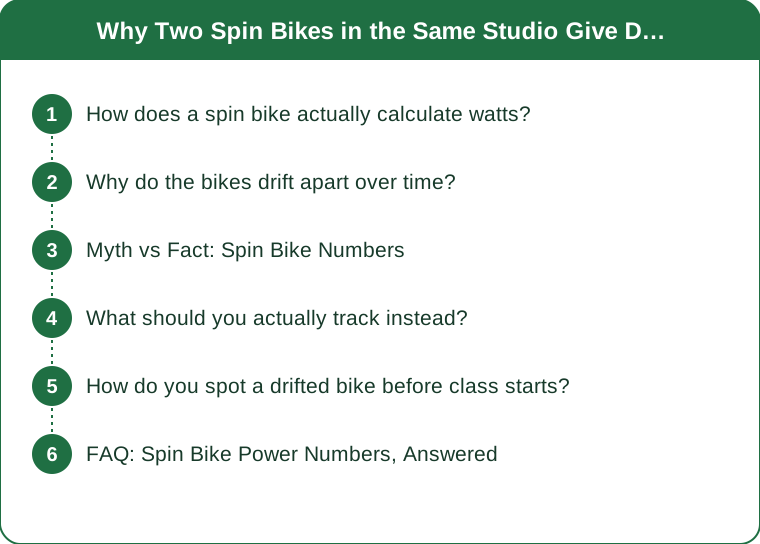
How does a spin bike actually calculate watts?
Most studio bikes infer power rather than measure it, using flywheel speed plus the position of the resistance mechanism.
That inference relies on a factory curve describing how much drag a given resistance setting should produce.
The curve stops being true as the bike ages - pads wear, magnets shift, belts stretch, and the actual drag at setting 15 slowly changes.
Bikes with a genuine strain gauge measure force directly and hold accuracy far better, but they are the minority in group studios.
Nothing on the console tells you which type you are riding, which is why two people can have completely different experiences of the same leaderboard.
The practical consequence is that your watts are comparable to your own watts on that bike, and to very little else.
Why do the bikes drift apart over time?
Friction bikes drift fastest because the pad is a consumable and its grip changes as it wears and as it picks up dust.
Magnetic bikes drift more slowly but still move as the mechanism loosens and the gap between magnet and flywheel changes by a millimetre.
Usage is never even across a studio. The bikes near the fan and the instructor get ridden far more than the back corner, so they age at different rates.
Calibration is a maintenance task that studios do on a schedule, not continuously, which means the spread between bikes is widest just before a service.
Belt tension changes with temperature and humidity, so an unusually warm or damp room shifts every bike slightly.
None of this is a studio failing - it is simply what happens to mechanical estimation over thousands of rides.
Myth vs Fact: Spin Bike Numbers
Myth: the leaderboard compares riders fairly. Fact: it compares bikes as much as riders. A rider on a well-calibrated bike is competing against people on drifted ones in both directions.
Myth: a higher number means you worked harder. Fact: it can equally mean the resistance mechanism on that bike produces more drag per setting than the one you rode last week.
Myth: cadence is the reliable number. Fact: cadence is measured rather than inferred, so it genuinely is the more trustworthy figure on most consoles.
Myth: your own bike at home is accurate because it is new. Fact: new only means it matches its factory curve, which was never a precise measurement of you.
Myth: calibration fixes everything. Fact: calibration re-aligns the bike to its curve; it does not turn an estimate into a measurement.
Myth: the numbers are therefore useless. Fact: they are excellent for pacing within a single ride on a single bike, which is what they were designed for.

What should you actually track instead?
Ride the same bike whenever you can and note its number. This single habit removes most of the confusion.
Track your own trend on that bike over weeks, not your position relative to the room.
Use cadence and heart rate as the cross-check, since both are measured rather than modelled.
Rate of perceived exertion is more portable than watts across bikes, studios, and brands, which is why coaches keep using it.
If the studio publishes a calibration schedule, ride shortly after it for your benchmark efforts.
And compare classes only when the conditions match - same bike, similar room temperature, similar time of day.
How do you spot a drifted bike before class starts?
Spin the flywheel with zero resistance and see how long it takes to slow. A bike that stops quickly has drag it should not have.
Turn the resistance up and down through its range and feel whether the change is smooth or stepped - a stepped feel usually means a worn pad.
Listen at speed. A rubbing or ticking sound means something is contacting that should not be.
Check the console reads zero watts when the flywheel is still, since a non-zero baseline shifts every number that follows.
Look at the pad or magnet housing if it is visible; visible grooving is a clear sign.
And if the numbers on one bike are consistently far off your normal range in either direction, tell the front desk rather than assuming your fitness changed overnight.
FAQ: Spin Bike Power Numbers, Answered
How much can two studio bikes differ?
Commonly 10 to 20 percent, occasionally more on heavily used friction bikes that are due for service.
Which number on the console is most trustworthy?
Cadence, because it is measured directly rather than inferred from a resistance curve.
Should I stop looking at the leaderboard?
No - just read it as a ranking within that class on that hardware rather than a measure of your fitness.
Does my heart rate solve the problem?
It gives you a bike-independent signal, though it lags effort and shifts with heat, sleep, and caffeine.
Why were my numbers great one week and terrible the next?
Most often a different bike. Check the bike number before assuming anything about your training.
Are home bikes more accurate?
Only in the sense that you always ride the same one. That consistency is what makes the numbers useful. This is general information, not medical advice.
TL;DR:
- Most studio bikes estimate power from a factory resistance curve rather than measuring force, so accuracy drifts as they wear.
- Differences of 10 to 20 percent between bikes in the same room are normal, not a sign your fitness changed.
- Cadence is measured rather than inferred and is the more trustworthy console number.
- Ride the same bike each week and track your own trend on it; treat the leaderboard as a within-class ranking.
- A quick freewheel spin and a zero-watts check before class will tell you if a bike is badly drifted.
Pick a bike, learn its numbers, and let the rest of the room ride their own. This is general information, not medical advice.
Keep Reading
This article is for general informational and styling purposes only. Fit, sizing, and product availability may vary.