Why Your Breathing and Not Your Legs Should Set Your Resistance
Quick Answer: Leg burn tells you about local muscular fatigue, which is heavily influenced by cadence, gearing and how fresh you are — it is a poor guide to how hard the session actually is. Breathing tracks whole-body effort far more reliably, and it works on any bike with no calibration. Use the talk test: full sentences means easy, short phrases means moderate, single words means hard. Setting resistance by breath produces better-paced classes and stops the common pattern of blowing up in the first fifteen minutes.
The display numbers differ between bikes.
Your breathing does not.

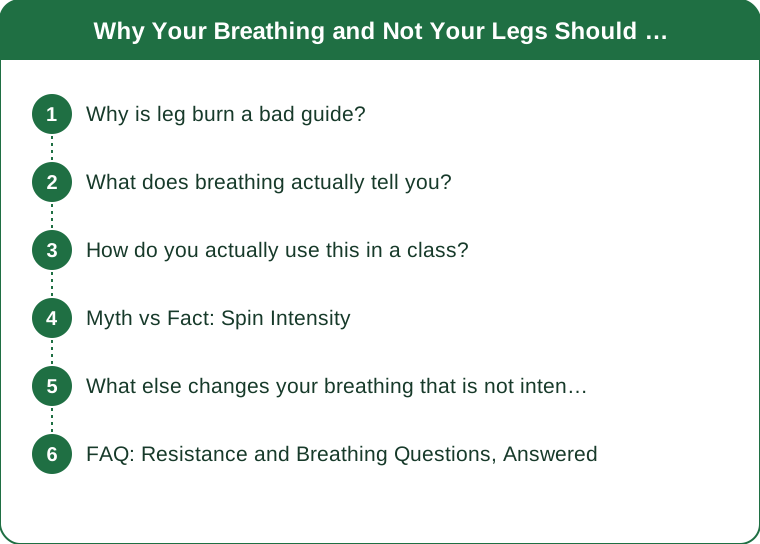
Why is leg burn a bad guide?
Because it measures something narrower than you think it does.
Burning legs indicate local muscular fatigue in the working muscles — a combination of metabolic byproducts, recruitment of larger muscle fibres and the sensation that accompanies them. That sensation is real and it is informative about your quadriceps. It is not a reliable proxy for your overall training intensity.
Three reasons it misleads:
It depends heavily on cadence. The same power output at 60rpm with high resistance produces far more leg burn than at 95rpm with less. Same work, very different local sensation. Someone grinding a heavy gear slowly feels like they are working extremely hard while their cardiovascular system is doing comparatively little.
It depends on freshness. Legs that trained yesterday burn earlier at the same intensity. Set resistance by burn and you will systematically under-train when tired and, more dangerously, mis-read what you are actually doing.
It saturates. Beyond a point, harder does not feel proportionally more burning. The signal loses resolution exactly where you need it.
Breathing has none of these problems. It responds to overall metabolic demand and it scales smoothly across the entire range of intensities, which is precisely what you want from a gauge.
What does breathing actually tell you?
A remarkably good approximation of your training zone, without any equipment.
Breathing rate and depth rise with the body’s demand for oxygen and its need to clear carbon dioxide. As intensity climbs, ventilation increases — first gradually, then more steeply at identifiable points that correspond reasonably well to physiological thresholds used in structured training.
The practical version is the talk test, which has been studied as a field method for estimating intensity and holds up reasonably well:
Full sentences, comfortably. Easy aerobic. You could keep this up for a long time. This is where most of the volume in a well-structured week should live.
Short sentences, needing a breath between. Moderate to threshold. Sustainable for a decent stretch but requiring attention.
A few words at a time. Hard. Sustainable for minutes, not tens of minutes.
Single words or none. Very hard. Intervals only, measured in seconds to a couple of minutes.
The useful part is that you can check it silently — you do not need to speak. Ask yourself whether you could say a full sentence right now. The answer is immediate and honest.
How do you actually use this in a class?
Set the resistance so your breathing matches the intended zone of the block, and let the leg sensation be whatever it is.
During a warm-up: full sentences throughout. If you cannot, the resistance is too high regardless of what the instructor called for, and you are borrowing from the rest of the class.
During a long endurance block: short sentences. This is the zone people most commonly overshoot, because it feels too easy to be worth doing and the room is being encouraged upwards.
During a threshold effort: a few words. Sustained, uncomfortable, controllable. If you are down to single words in minute two of a ten-minute block, you have set it too high and you will fade.
During short intervals: whatever it takes, and use recovery breathing to judge readiness for the next one. This is the most useful application on the list — if your breathing has not come back to short sentences by the end of the recovery period, the interval was too hard or the recovery too short, and the next one will be worse.
During recovery: the goal is for breathing to settle noticeably. If it does not, reduce resistance rather than pushing on. Recoveries that do not recover turn an interval session into a long slog at an unproductive intensity.
One consequence worth naming: this will sometimes mean using less resistance than the instructor calls for, and that is a legitimate decision rather than a failure. Class cues are aimed at an average rider who does not exist.

Myth vs Fact: Spin Intensity
Myth: More resistance always means a better workout.
Fact: More resistance at too low a cadence shifts the work towards local muscular endurance and away from cardiovascular training. If the aim is fitness, breathing is the better target. If the aim is leg strength, there are more efficient ways to train it.
Myth: The bike’s numbers tell you how hard you are working.
Fact: Only if the bike is calibrated and consistent, and most studio bikes are neither. Resistance levels and power readings differ substantially between bikes and drift with wear. Your breathing is the same instrument every time.
Myth: If you are not gasping, you are not working.
Fact: Most of a well-structured endurance programme sits at an intensity where you could still hold a conversation. Sessions where everyone gasps for forty-five minutes tend to be less effective than they feel.
Myth: Heavy legs the next day means a good session.
Fact: It mostly means high muscular load, which is influenced heavily by cadence and by how unaccustomed the work was. It is not a measure of cardiovascular benefit.
Myth: Breathing hard early is fine because you settle in.
Fact: This is the pattern that ruins the most classes — the first ten minutes feel deceptively easy because you are fresh and adrenalised, people set resistance from that feeling, and the bill arrives at minute twenty. Judge your resistance from your breathing at minute twelve, not at minute two.
What else changes your breathing that is not intensity?
Worth knowing, so you do not misread the signal.
Room temperature. A hot, crowded studio raises heart rate and ventilation at any given power output. On a warm evening you will breathe harder for the same work, and this is not a fitness problem. As studios shift to keeping the heating on this time of year, sessions genuinely get harder without the workout changing.
Air quality and crowding. A packed class in a room with poor ventilation feels harder for everyone in it.
Hydration and how recently you ate. Both affect heart rate and perceived effort noticeably.
Sleep. A poor night raises perceived effort at any intensity, and the talk test will accordingly put you in a higher zone for the same resistance. That is not a false reading — you genuinely are working harder relative to your capacity that day, and the right response is to reduce the resistance rather than override the signal.
Illness and the week after it. Elevated breathing and heart rate at easy intensities is a well-recognised sign that you are not recovered. Training through it is how a minor illness becomes a fortnight off.
Position on the bike. A cramped or over-reached position restricts breathing mechanically. If your breathing feels laboured out of proportion to your legs, check your setup before you conclude anything about your fitness.
If you experience chest pain, unusual breathlessness, dizziness or an irregular heartbeat during exercise, stop and seek medical advice. This is general fitness information, not medical advice.
FAQ: Resistance and Breathing Questions, Answered
Do I need a heart rate monitor instead?
Useful and not necessary. Heart rate has its own lag and its own confounders — heat, caffeine, sleep, stress — and breathing responds faster to changes in intensity. A monitor adds precision if you like data; the talk test is available to everyone right now.
What if I cannot tell what zone I am in?
Actually say a sentence out loud, quietly, a few times during a class. Once you have calibrated what each zone feels like, the silent check becomes reliable within a couple of sessions.
Should I ignore the instructor’s resistance cues entirely?
No — use them as a direction and your breathing as the amount. “Add resistance” is useful information about the shape of the class; how much you add is yours to decide.
Why do my legs give out before my breathing?
Usually cadence — you are grinding a heavy gear slowly. Try adding 10 to 15rpm and reducing resistance for the same perceived effort, and see whether the balance shifts. Some people are genuinely limited by leg strength, but far fewer than the sensation suggests.
Does this apply to outdoor cycling?
Identically, and it is arguably more useful outdoors where gradient and wind make power output vary constantly. Breathing gives you a stable target when the terrain does not.
How do I know if I am going too easy?
If you can hold a full conversation comfortably through what is supposed to be a hard block, add resistance. The talk test cuts both ways, and its most common use is stopping people going too hard rather than too easy.
TL;DR:
- Leg burn tracks local muscular fatigue and varies with cadence and freshness, so it is a poor intensity gauge
- Breathing tracks whole-body effort and works identically on every bike with no calibration
- Use the talk test: full sentences easy, short sentences moderate, few words hard, single words very hard
- Judge your resistance from minute twelve, not minute two — the first ten minutes always feel deceptively easy
- Heat, poor sleep and illness raise your breathing at the same workload, and the right response is less resistance
In your next class, silently ask yourself whether you could say a full sentence at three points during the ride. That one check will change how you set the dial more than any number on the display.
Keep Reading
This article is for general informational and styling purposes only. Fit, sizing, and product availability may vary.