Why Saddle Fore-Aft Position Decides More Than Saddle Height
Quick Answer: Saddle height sets how far your leg extends; fore-aft position sets where the load lands on your knee. A saddle too far forward loads the front of the knee, and too far back loads the back of it and the hamstring. The standard check is knee directly over the pedal spindle with the crank horizontal — and getting it right fixes knee pain that no amount of height adjustment will touch.
You have raised the saddle. You have lowered it. You have gone back to where you started.
Your knee still hurts in the same spot, at the same point in every class.
That is because the knob you have been turning is not the one controlling that. There are two saddle adjustments on every spin bike and most riders only ever use one.
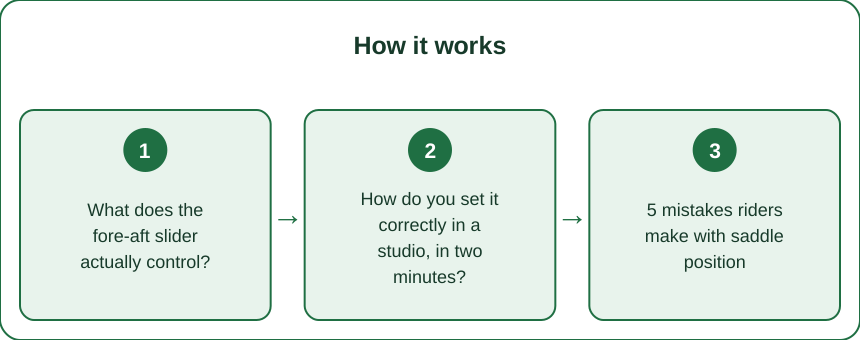
What does the fore-aft slider actually control?
It controls where your knee sits relative to the pedal at the point of maximum force.
Picture the pedal stroke. The hardest part is roughly between one and three o’clock, when the crank is close to horizontal and you are pushing down and forward.
Where your knee is at that moment determines which structures take the load.
If the saddle is too far forward, your knee sits ahead of the pedal at that point. The force vector shifts to the front of the joint — quadriceps, patellar tendon, kneecap. This produces the classic front-of-knee ache and is the single most common setup error on spin bikes.
If the saddle is too far back, your knee sits well behind the pedal. You get more hamstring and glute involvement, which sounds good, but at the extreme it produces back-of-knee tightness and a rocking pelvis as you reach for the bottom of the stroke.
Height cannot fix either of these. Raising the saddle makes your leg straighter; it does not move your knee forward or back relative to the pedal in any meaningful way. That is why people cycle through height settings for weeks without resolving anything.
How do you set it correctly in a studio, in two minutes?
You do not need a plumb line, though it helps. Here is the practical version.
1. Set the height first. Heel on the pedal at the bottom of the stroke, leg fully straight, no rocking of the hips. Then clip in properly and you will have the standard slight bend.
2. Get the crank horizontal. Pedals level, front foot forward. Easiest with a friend holding the flywheel, or just balance it against the resistance.
3. Find the bony bump just below your kneecap on the front leg — the tibial tuberosity area, or simply the front point of the knee.
4. Drop an imaginary vertical line from there. It should pass through the pedal axle — the spindle in the middle of the pedal.
5. If it lands in front of the spindle, slide the saddle back. If behind, slide it forward. Adjust in half-inch increments, not more.
The realistic studio version: phone camera, someone films you from the side for five seconds while you hold the position, and you check it. It takes less time than the first song of the class.
One warning. Change fore-aft and you have effectively changed your effective saddle height too, because the saddle rails are angled. Re-check height after any significant fore-aft change, in that order.
5 mistakes riders make with saddle position
1. Setting fore-aft by reach to the handlebars. This is the big one. People slide the saddle forward because the bars feel far away. The bars are adjustable separately — move those instead, and leave fore-aft for the knee.
2. Using the same number on every bike. Fore-aft markings are not standardised between manufacturers, and even between bikes of the same model the slider position for the same geometry can differ. Set it by the knee check on an unfamiliar bike, not by a memorised number.
3. Adjusting mid-class in big jumps. An inch is enormous. If something feels off during class, move a half-inch at most and give it three or four minutes.
4. Assuming taller means further back. Fore-aft is about femur length and where your knee sits, not overall height. Two riders of the same height with different limb proportions can need noticeably different positions.
5. Never re-checking after new shoes. Cleat position on a cycling shoe shifts your foot relative to the pedal, which shifts your knee relative to the spindle. New shoes mean a fresh setup, and this is the one that catches people who have been riding for years without a problem.
Why does it feel fine at low resistance and hurt at high?
Because force reveals a setup error that a light load hides.
At low resistance you are spinning, not pushing. The force through the joint is small and slightly misdirected force does not accumulate into anything you notice.
Turn the resistance up and the same angular error is now multiplied by a much larger force. The direction of the load has not changed; the magnitude has. This is why front-of-knee pain in spin classes shows up specifically during climbs and standing efforts.
It is also why the problem is often blamed on the climbs themselves. Riders decide they should avoid heavy resistance, when the actual issue is that heavy resistance is the only thing exposing a saddle 15mm too far forward.
A useful test: if your knee pain appears only during climbs and disappears in flat road sections, check fore-aft before you reduce your resistance. If it hurts equally at all resistances, height and cleat position are the more likely culprits.
Persistent knee pain that does not resolve with setup changes is worth having looked at properly. This is general information, not medical advice.
Does this change when you stand up?
Yes, and it is the reason a position that works seated can feel wrong out of the saddle.
When you stand, your body moves forward and your weight shifts over the bars. Your knee position relative to the pedal changes substantially — it moves forward — regardless of where the saddle is.
That means the saddle setting is fundamentally a seated setting. You cannot optimise for both, and you should not try.
What you can do is manage the transition:
- Keep your hips back as you rise. The common error is throwing the hips forward over the bars, which exaggerates the forward knee position and loads the front of the joint hard.
- Add resistance before standing, always. Standing with light resistance means your bodyweight drops through the pedals with nothing supporting it, which is both inefficient and rough on the knees.
- Keep standing efforts shorter if you get front-of-knee discomfort. The position is inherently more forward-loaded.
If a class involves a great deal of standing work and your knees complain specifically then, the standing technique is more likely at fault than the saddle.
FAQ: Spin Bike Saddle Position, Answered
How often should I re-check my setup?
Any time you change shoes, come back after a break of more than a few weeks, or start getting new discomfort. Otherwise, once it is right it stays right on your own bike. In a studio, check the number every class — sliders move.
Should the saddle be level or tilted?
Level, for almost everyone. A nose-down tilt shifts weight onto your hands and quietly changes your effective fore-aft position as you slide forward through the class.
Can a bad fore-aft setting cause hip pain rather than knee pain?
It can. Too far back is the usual culprit — you reach for the bottom of the stroke, the pelvis rocks side to side, and that shows up as hip or lower back discomfort rather than knee pain.
TL;DR:
- Height sets leg extension; fore-aft sets where load lands on the knee. They fix different problems.
- Check with the crank horizontal and the knee directly over the pedal spindle, adjusting in half-inch steps.
- Never set fore-aft by handlebar reach — move the bars instead.
- Pain that appears only at high resistance points at fore-aft; pain at all resistances points at height or cleats.
If you have been chasing knee discomfort by moving the saddle up and down for weeks, spend two minutes on the slider before your next class instead. It is the adjustment almost nobody in the room has touched, and for the riders whose knees complain on climbs it is very often the entire answer.
Keep Reading
This article is for general informational and styling purposes only. Fit, sizing, and product availability may vary.