Why a Warm Spin Studio Makes the Same Class Feel Much Harder
Quick Answer: Indoor cycling removes the airflow that normally carries your heat away, so in a warm studio your body diverts blood to the skin for cooling and away from working muscle. Heart rate rises by 10 to 20 beats per minute at the same power, perceived effort climbs, and output falls — often by 10 to 20 percent in a hot room. It is a genuine physiological limit, not a fitness problem. Manage it with fluid, a fan, position in the room, and by pacing on power rather than heart rate.
This is also why your indoor numbers do not match your outdoor ones at the same effort.
This blog has covered why your legs burn out before your lungs, spin class heart rate zones versus RPE, and why the numbers do not match across different bikes. Room temperature explains more variance than any of them.
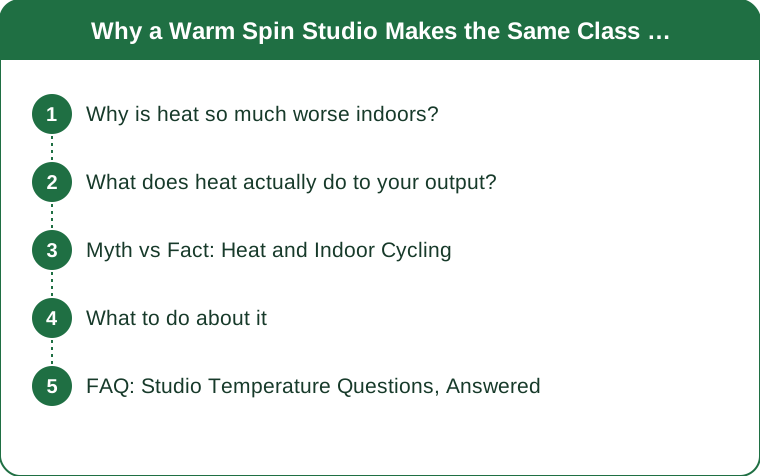
Why is heat so much worse indoors?
Because you are producing the heat of a fast ride while standing still in still air.
Cycling is roughly 20 to 25 percent efficient, meaning about three-quarters of the energy you produce becomes heat rather than motion.
Outdoors, moving at 30km/h provides constant convective cooling. That airflow is doing most of the work of removing that heat and you never notice it.
Indoors there is no airflow at all unless a fan provides it, so heat accumulates in a boundary layer of hot humid air around your skin.
Sweat only cools you when it evaporates. In a humid studio with thirty other people, the air near your skin saturates and sweat drips rather than evaporating, which cools you almost not at all.
A packed studio is a heat source in itself. Thirty riders each producing several hundred watts of heat raises room temperature and humidity substantially within twenty minutes.
Which is why the second half of a class feels disproportionately harder. You are not just fatigued; you are progressively less able to shed heat as the room’s humidity rises.
What does heat actually do to your output?
It creates a direct competition between cooling and performance, and cooling wins.
Blood flow gets diverted to the skin for cooling, which reduces the volume available to working muscle.
Stroke volume falls and heart rate rises to compensate. This is cardiac drift, and 10 to 20 beats per minute at the same power in a warm room is typical.
Which makes heart rate zones misleading indoors. Your zone 4 heart rate in a hot studio may be a zone 3 effort in power terms, and pacing on heart rate in heat leads you to systematically underperform.
Perceived effort rises independently of the physiology. Feeling hot makes an effort feel harder, and that alone reduces voluntary output.
Output drops meaningfully. Studies of endurance performance in heat consistently show reductions in the 10 to 20 percent range once core temperature rises significantly, and non-acclimatised riders are at the worse end.
And dehydration compounds it. Losing 2 percent of body mass in fluid — very achievable in a 45-minute hot class — reduces plasma volume and further impairs both cooling and performance.

Myth vs Fact: Heat and Indoor Cycling
Myth: A hot room means a better workout. Fact: It means a harder-feeling workout at lower output. You get a higher heart rate for less work, more fluid loss, and typically a worse training stimulus for the same discomfort.
Myth: Sweating more means burning more. Fact: Sweat rate reflects cooling demand, not energy expenditure. You can sweat heavily in a sauna while expending almost nothing.
Myth: Your fitness dropped if your numbers fell. Fact: Check the room first. A 10 to 20 percent output drop is a textbook heat response, and it reverses completely in a cooler room or with a fan.
Myth: Heat training is good for you, so hot classes are a bonus. Fact: Genuine heat acclimatisation is a structured protocol of controlled sessions over one to two weeks. Randomly overheating in classes gives you the cost without the programming, and it degrades the quality of every session it touches.
Myth: You should drink to thirst and no more. Fact: Thirst lags fluid loss during high sweat rates. For a hot 45-minute class, aim for roughly 500 to 750ml during the session and drink before you feel thirsty. Add electrolytes if you sweat heavily or the class runs long.
Myth: The fan is for comfort. Fact: The fan is the single most effective performance intervention available indoors. Airflow restores evaporative cooling, and riders with direct airflow consistently produce more power for the same heart rate than those without.
What to do about it
Nearly all of it is controllable and none of it requires more fitness.
Get airflow on you. Pick a bike near a fan, bring your own if the studio allows it, and point it at your torso and head rather than your legs.
Choose your position in the room deliberately. Back corners and areas away from ventilation are consistently hotter. Near a door or a vent is worth arriving early for.
Pre-cool. Arriving warm from a rush or a hot commute puts you behind from the first minute. A cold drink before class genuinely helps.
Drink 500 to 750ml during a hot 45-minute class, starting early rather than when you feel thirsty, and add electrolytes for longer or hotter sessions.
Pace on power or RPE, not heart rate. In heat your heart rate lies about your effort, and following it will cause you to back off from a sustainable power.
Wear less and choose fabrics that move moisture. A wet cotton top is an insulating layer; a light technical fabric is not.
And compare your numbers to yourself in similar conditions. Comparing a hot Saturday class to a cool Tuesday one tells you about the rooms, not about you.
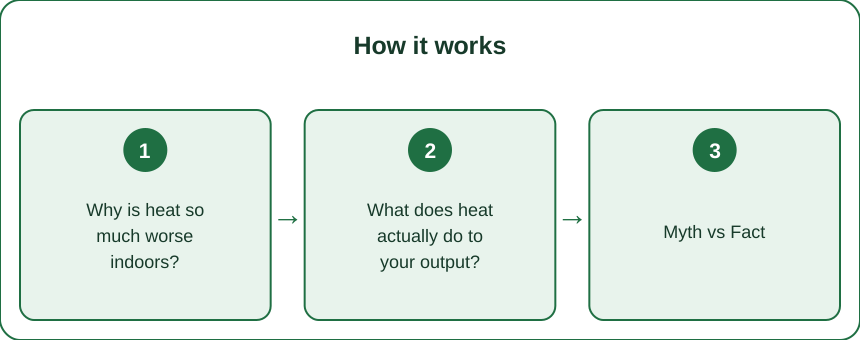
FAQ: Studio Temperature Questions, Answered
Why is my spin performance worse in a hot studio?
Because blood is diverted to the skin for cooling and away from working muscle, stroke volume falls, and heart rate rises to compensate. Output typically drops 10 to 20 percent in genuinely hot conditions, which is a physiological limit rather than a fitness issue.
Should I use heart rate zones in a hot spin class?
No, or at least not without adjustment. Cardiac drift adds 10 to 20 beats per minute at the same power in heat, so heart rate zones will consistently tell you to ride easier than you can sustain. Pace on power or perceived exertion instead.
How much should I drink during a spin class?
Roughly 500 to 750ml for a hot 45-minute class, starting early rather than waiting for thirst, which lags actual fluid loss. Add electrolytes if you are a heavy sweater or the session runs beyond an hour.
TL;DR:
- Three-quarters of your cycling energy becomes heat, and indoors there is no airflow to remove it.
- Heat diverts blood to the skin, drops stroke volume and adds 10 to 20bpm at the same power. Output falls 10 to 20 percent.
- The fan is a performance tool, not a comfort item. Airflow on your torso is the highest-return change available.
- Pace on power or RPE in heat. Heart rate zones will tell you to ride easier than you actually can.
If your numbers dropped without warning, check the room temperature before you question your training.
Keep Reading
This article is for general informational and styling purposes only. Fit, sizing, and product availability may vary.