Why You're Never Sure If Your Spin Bike Resistance Is Actually Right
Quick Answer: Resistance is right when you can maintain the instructor’s called-out cadence without bouncing in the saddle or completely losing your breath — using perceived effort rather than trying to match a specific number on the dial is the more reliable approach for most riders.
The instructor says “add a quarter turn” and you have no idea if you just did too little or too much. You’re not alone — the dial itself gives almost no useful feedback.

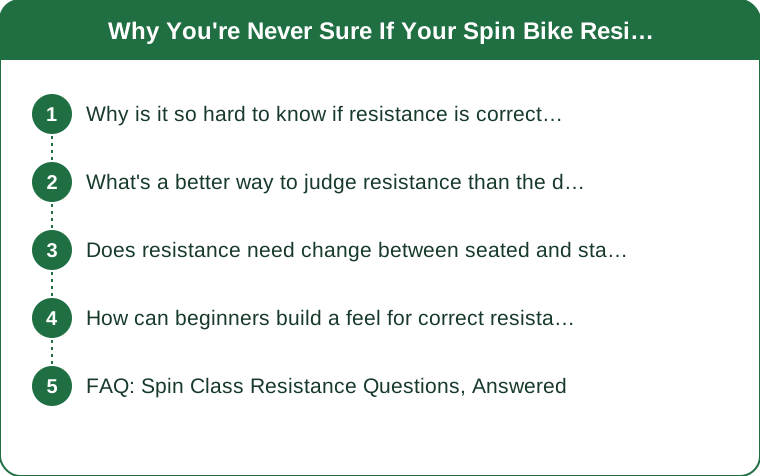
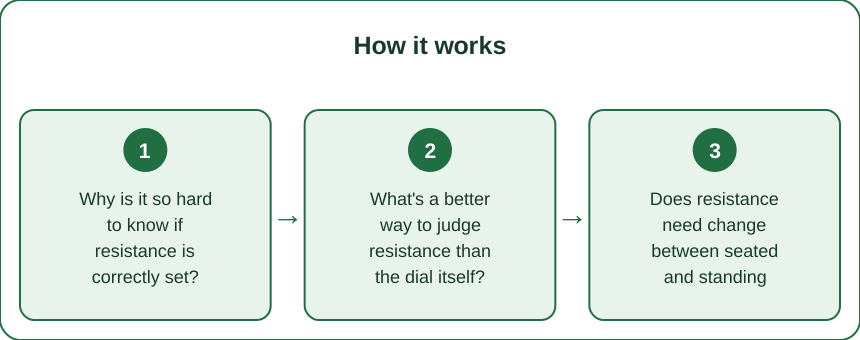
Why is it so hard to know if resistance is correctly set?
Most spin bike resistance dials give no objective numeric readout, unlike a bike with a digital resistance display — you’re relying entirely on feel, which is genuinely difficult to calibrate as a beginner without a reference point for what “correct” actually feels like. This is a real design limitation of most studio bikes, not a sign you’re doing something wrong as a rider.
Even experienced riders on unfamiliar bikes (different studios, different bike brands) often need a few minutes to recalibrate, since resistance dials aren’t standardized across brands the way, say, a treadmill’s speed display is.
What’s a better way to judge resistance than the dial itself?
Perceived cadence control — if you’re bouncing out of the saddle involuntarily during a seated segment, resistance is too low; if you can’t maintain the called-out cadence at all and your legs feel like they’re grinding to a stop, it’s too high. The sweet spot is resistance that lets you hit the target cadence while still feeling meaningfully challenged, not effortless and not impossible.
During standing climbs specifically, you should feel stable and controlled, not thrown forward onto the handlebars — that instability is a common sign resistance is too low for a standing effort, regardless of what the dial number suggests.

Does resistance need change between seated and standing segments?
Generally, yes — standing typically requires more resistance than seated riding at the same cadence, since standing removes some of the stabilizing support the saddle provides and uses body weight differently to drive the pedal stroke. Instructors often cue an increase when transitioning to standing work for exactly this reason, not arbitrarily.
Failing to add resistance when standing is one of the most common technique gaps in spin class — riders who don’t increase it often end up bouncing or losing form, which reduces the workout’s effectiveness and can strain the knees over a full class.
How can beginners build a feel for correct resistance faster?
Spend the first few classes paying deliberate attention to how a specific resistance level feels at a specific cadence, rather than only following instructor cues passively. Building this internal reference over several sessions is what eventually makes resistance adjustments feel intuitive rather than guesswork.
Some studios use branded resistance/output metrics (watts or a proprietary score) on connected bikes, which can help beginners build a numeric reference faster than dial-feel alone — worth using if your studio’s bikes offer it, even as a temporary training wheel while you build intuition.
FAQ: Spin Class Resistance Questions, Answered
Is it bad to keep resistance lower than the instructor suggests?
Not inherently — resistance should match your current fitness and how your body feels that day, not exactly match a called-out cue every time.
Why do my legs feel fine but I can’t hit the target cadence?
This is often a resistance-too-high situation — try backing off slightly rather than pushing through with poor cadence control.
Does bouncing in the saddle always mean resistance is too low?
Usually, yes, though it can occasionally reflect fatigue late in a long class — check resistance first since it’s the more common and easier fix.
TL;DR:
- Most spin bike dials give no objective readout, making feel-based judgment necessary
- Bouncing in the saddle usually signals resistance too low; grinding to a stop signals too high
- Standing segments generally need more resistance than seated riding at the same cadence
- Building a resistance-to-cadence reference over several classes makes adjustments more intuitive
Next class, pay close attention to exactly how one resistance level feels at one specific cadence — that reference point is what eventually makes the dial make sense.
Keep Reading
This article is for general informational and styling purposes only. Fit, sizing, and product availability may vary.