Should You Train Spin Class by Heart Rate Zones or by Feel (RPE)?
Quick Answer: Heart rate zones give objective, trackable data especially useful for structured interval training, while RPE (rate of perceived exertion) responds instantly to real-time factors like heat, sleep, and stress that heart rate can lag behind. Most riders benefit from using both together rather than picking just one.
Your instructor calls out zone 4, your watch says you’re barely in zone 2, and now you’re second-guessing your own effort mid-class. Understanding what each measurement actually tells you clears up more confusion than it seems like it should.

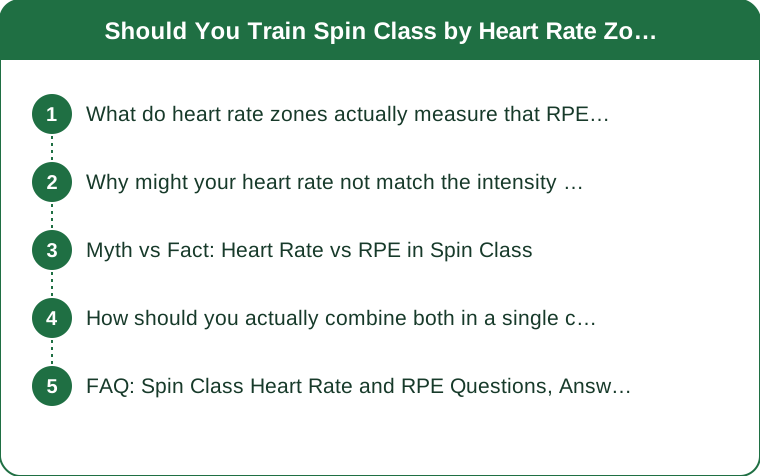
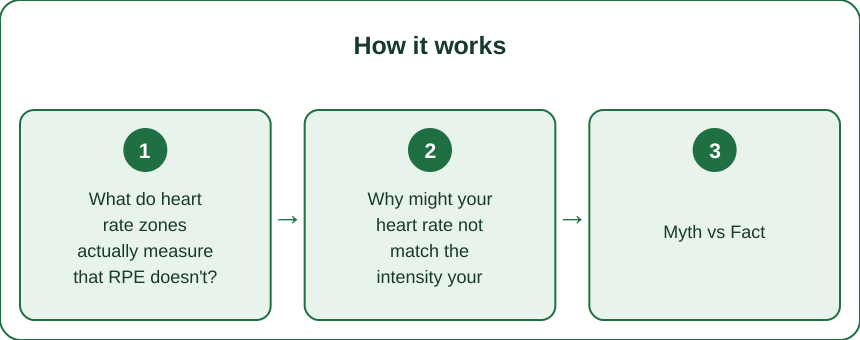
What do heart rate zones actually measure that RPE doesn’t?
Heart rate zones give an objective, numeric readout of cardiovascular effort based on your individual max heart rate, which makes it useful for consistently replicating a specific intensity across different sessions or tracking progress over weeks and months. RPE is subjective — a 1-10 scale of how hard something feels — which varies day to day based on sleep, stress, caffeine, and general fatigue, even when the actual physical output is identical.
This is exactly why the two can disagree: your heart rate might be objectively in zone 3, but if you’re exhausted or dehydrated, it can feel like zone 4 or 5 — and that felt effort is real information too, not something to dismiss.
Why might your heart rate not match the intensity your instructor is calling out?
Instructor cues are built around a general class average, not your specific fitness level, resting heart rate, or how well your particular monitor is calibrated. Chest strap monitors tend to be more accurate than wrist-based sensors, especially during high-cadence movement where wrist monitors can lose an accurate read from motion artifacts.
If your numbers consistently run lower than what’s called out, it might mean you’re genuinely more conditioned than the class average — or simply that your monitor and the instructor’s assumed zones don’t line up. Either way, it’s not something to panic about mid-class.

Myth vs Fact: Heart Rate vs RPE in Spin Class
Myth: Heart rate is always the more accurate measure of true effort. Fact: Heart rate can lag behind sudden intensity changes by 15-30 seconds, meaning RPE sometimes reflects the actual demand on your body faster than a monitor does.
Myth: RPE is just guessing, so it’s not a real training tool. Fact: RPE is a validated method used in real exercise science and coaching, not an informal substitute — it’s simply subjective rather than device-measured.
Myth: You should always chase the exact zone your instructor calls out. Fact: Your own zones, based on your actual max heart rate, matter more than a generic class-wide cue — training to someone else’s zone 4 can mean overtraining or undertraining relative to your real capacity.
How should you actually combine both in a single class?
Use heart rate as your primary number for structured interval work — hitting a specific zone for a specific interval duration — since it gives objective consistency across sessions. Use RPE as a safety check and daily calibration tool: if your heart rate says zone 2 but everything feels like an all-out zone 5 effort, that mismatch is worth listening to and easing off for, rather than pushing through based on the number alone.
Over time, comparing the two builds a much better internal sense of your own effort levels, which becomes useful even on days you don’t have a monitor at all.
FAQ: Spin Class Heart Rate and RPE Questions, Answered
How do I find my actual heart rate zones instead of using a generic estimate?
A rough starting formula (220 minus your age for estimated max heart rate) works as a starting point, though a fitness assessment or sports physician can give more precise, individualized zones if you want more accuracy.
Why does my heart rate stay high even after I ease off resistance?
This is called heart rate lag — your cardiovascular system takes a short time to catch up with reduced effort, which is completely normal and not a sign anything is wrong.
Should beginners worry about heart rate zones at all?
Not much at first — for beginners, RPE and simply being able to hold a conversation at moderate effort is a perfectly good guide; zone-specific training becomes more useful once you have a consistent baseline fitness level established.
TL;DR:
- Heart rate offers objective, trackable data; RPE reflects real-time factors heart rate can lag behind
- Instructor-called zones are generic — your own individual zones matter more for your training
- Use heart rate for structured intervals, RPE as your daily safety check
- Beginners can rely mostly on RPE until a consistent fitness baseline is established
Neither number is lying to you — they’re just measuring slightly different things. Let them inform each other instead of picking a side. This is general information, not medical advice.
Keep Reading
This article is for general informational and styling purposes only. Fit, sizing, and product availability may vary.