How to Read Spin Bike Numbers Without Being Misled by Them
Quick Answer: Most studio spin bikes estimate power rather than measure it, and estimates vary between bikes, drift with calibration and change with maintenance. That means the number is useful for comparing your own efforts on the same bike on the same day, and much less useful for comparing across bikes, across studios, or against other people. Use it for pacing within a class, track your trend rather than absolute values, and pick the same bike where you can.
You put out 220 watts last Tuesday and 265 on Thursday with less effort.
You did not get 20 percent fitter in 48 hours. You got a different bike.

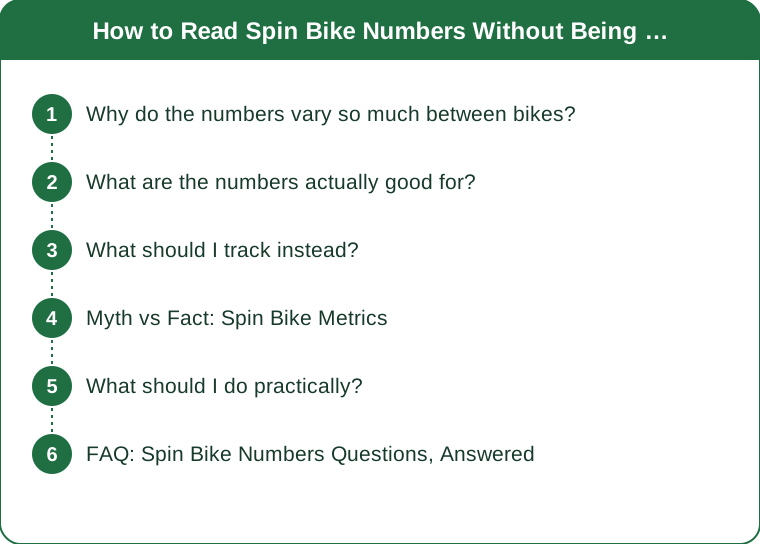
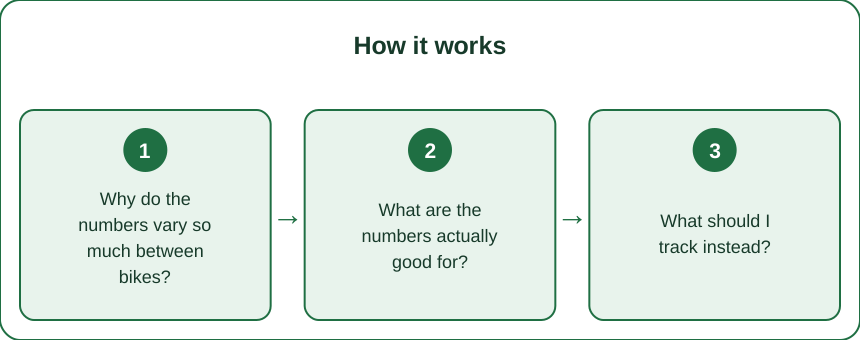
Why do the numbers vary so much between bikes?
Because most studio bikes estimate power from resistance setting and cadence rather than measuring force directly with a strain gauge.
Estimation depends on assumptions about the resistance mechanism, and those assumptions drift as parts wear.
Friction-based resistance is particularly variable, since pad wear, dust, humidity and temperature all change the relationship between the resistance knob and actual resistance.
Magnetic resistance is more stable but is still usually estimated rather than measured.
Calibration schedules vary enormously between studios, and a bike that has not been calibrated in months can be substantially off.
Which means the same effort genuinely produces different numbers on different bikes, and neither number is wrong so much as neither is absolute.
What are the numbers actually good for?
Pacing within a single class. If your number drops 20 percent in the last interval, that is real information about your effort regardless of calibration.
Comparing efforts on the same bike on the same day, which is the most reliable comparison available.
Trend over time on the same bike, if you can consistently get the same one - which is why regulars have a bike.
Structuring intervals, since relative targets work fine even when absolute values do not.
What they are not good for: comparing yourself to other people in the room, comparing across studios, or drawing conclusions about your fitness from absolute wattage.
And the leaderboard is a motivational tool, which is fine as long as you know that is what it is.
What should I track instead?
Heart rate, which is measured rather than estimated and is consistent across bikes because the sensor is on you.
Rate of perceived exertion, which sounds unscientific and correlates well with physiological measures in practice.
Your own relative numbers within a session - what percentage of your maximum effort each interval represented.
How you feel at the same point in the same class format, which over weeks is a genuinely useful fitness signal.
Cadence, which is counted rather than estimated and is therefore more reliable than power on most bikes.
And if you are serious about power, a power meter on your own pedals travels with you and removes the whole problem.

Myth vs Fact: Spin Bike Metrics
Myth: watts are watts. Fact: a measured watt is a watt, but an estimated watt is a calculation with assumptions baked in, and those assumptions differ between bikes and drift over time.
Myth: the leaderboard shows who worked hardest. Fact: it shows who produced the highest estimated numbers on their particular bike, which is affected by bike calibration and by body weight. It is a game, and treating it as one is the healthy approach.
Myth: more resistance is always better training. Fact: heavy resistance at low cadence is one type of stimulus. Higher cadence at lower resistance is another, and both belong in a programme. Cranking resistance to top the leaderboard often just degrades your form.
Myth: calories burned on the console is accurate. Fact: it is an estimate derived from an estimate, usually without accounting properly for your individual characteristics. Treat it as very approximate.
Myth: your numbers should improve every week. Fact: they fluctuate with sleep, fuelling, cycle phase, room temperature and which bike you got. Look at monthly trends, not weekly ones.
Myth: an uncalibrated bike makes the class worthless. Fact: the class is fine - the session’s training effect does not depend on the console. Only your data comparison does.
What should I do practically?
Pick the same bike each time if you can, which is the single most useful habit for anyone tracking their numbers.
Note the bike number in your log, so an anomalous session can be explained rather than worried about.
Wear a heart rate monitor if you want data that travels with you.
Ask the studio about their calibration schedule, which is a reasonable question and tells you how much to trust the console.
Use relative targets in class - hard, moderate, easy as percentages of your own effort rather than absolute numbers.
And do not chase a personal best on an unfamiliar bike, which is how people either feel unnecessarily bad or push into poor form chasing a number that was never comparable.
FAQ: Spin Bike Numbers Questions, Answered
Are spin bike watts accurate?
Most studio bikes estimate rather than measure power, so accuracy varies by bike, by model and by how recently it was calibrated. Consistency on the same bike is far better than absolute accuracy.
Why are my numbers different every week?
Most commonly a different bike. Also sleep, fuelling, room temperature and general fatigue. Track monthly trends on the same bike rather than reading week to week.
Should I ignore the leaderboard?
Not necessarily - it is motivating for a lot of people. Just treat it as a game rather than as a measure of fitness, since it is affected by bike calibration and body weight.
Is heart rate a better metric?
It is measured rather than estimated and travels with you, which makes it more consistent. It has its own limitations - it lags effort and is affected by heat, caffeine and fatigue.
Can I compare my studio numbers to outdoor cycling?
Not reliably, unless both are measured with a calibrated power meter. Estimated indoor numbers and outdoor power meter numbers are not the same measurement.
What about calories on the display?
Very approximate. It is an estimate built on an estimate, and it typically does not account well for individual differences. Use it as a rough relative marker at best.
TL;DR:
- Most studio bikes estimate power rather than measure it, and estimates drift with wear and calibration.
- Numbers are reliable for comparing your own efforts on the same bike on the same day.
- They are unreliable across bikes, across studios and between people.
- Pick the same bike, note its number, and track monthly trends rather than weekly ones.
- Heart rate and perceived exertion travel with you and are more consistent.
- The leaderboard is a motivational game affected by calibration and body weight.
Use the console to pace the class, not to measure your fitness.
Keep Reading
This article is for general informational and styling purposes only. Fit, sizing, and product availability may vary.